


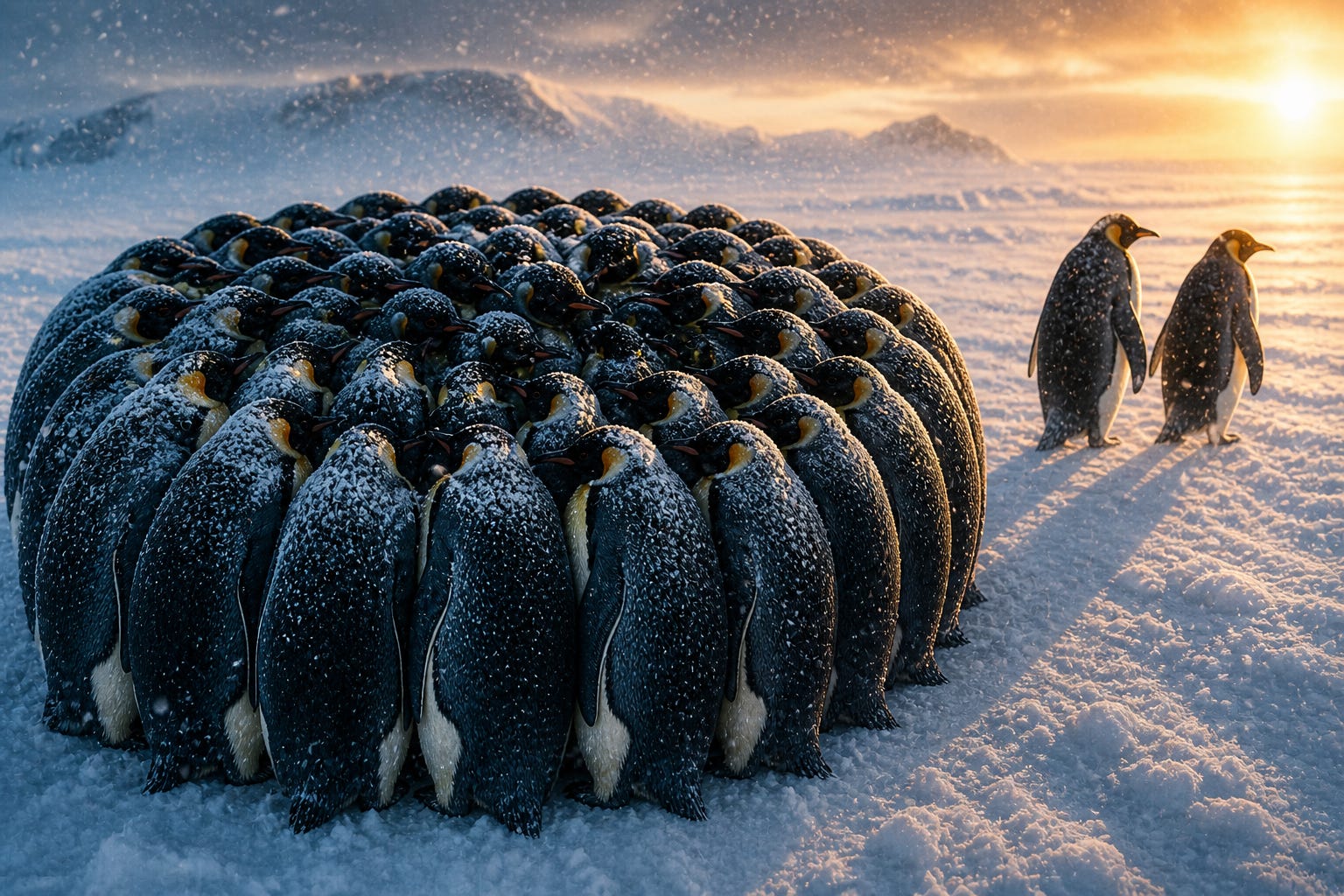
In one of the harshest environments on Earth, the emperor penguin survives not by strength alone, but by strategy. When Antarctic temperatures plunge below -50°C (-58°F), these penguins form tightly packed huddles that act like living furnaces. Inside the group, temperatures can soar to nearly 37.5°C (99.5°F), warm enough to rival the human body. But this warmth comes at a cost, those in the center can overheat, while those on the edges endure freezing winds.
So what happens? They rotate.
In a slow, wave-like motion, penguins from the outside gradually move inward, while those who have warmed up shift outward. No leader. No command. Just instinctive cooperation, what scientists call social thermoregulation. It’s not about affection; it’s about survival. If even a few refused to participate, the system would collapse, and many would perish.
This “heat math” is a powerful picture of how God designed us to live, not in isolation, but in intentional, life-giving community.
The Bible echoes this truth clearly:
“Two are better than one… If either of them falls down, one can help the other up.” — Ecclesiastes 4:9–10
“Carry each other’s burdens, and in this way you will fulfill the law of Christ.” — Galatians 6:2
Just like the penguins, we all have seasons where we’re on the “outside”, facing cold, pressure, or hardship. And other times, we’re in the “center”, strong, supported, and able to give back. God never intended for us to stay in one position. Life in Christ is a rhythm of receiving and giving, leaning and lifting.
But here’s the challenge: cooperation isn’t always natural for us. Pride, independence, or fear can make us resist the very relationships that would sustain us. Yet the penguins remind us, survival, growth, and even spiritual warmth depend on unity.
Even Jesus Christ surrounded Himself with others. He built a community, shared burdens, and taught His followers to love one another deeply. If the Son of God chose not to walk alone, neither should we.
Take the Next Step
Think about where you are right now: Are you on the “edge” needing support, or in the “center” able to give it? Reach out to someone today, either to ask for help or to offer encouragement. Commit to being part of a community where people rotate in care, not compete for position.
I was at Sea World the other day. Emperor penguins are amazing!!!!!!!!
Love this.. how smart is our creator.. just like birds don’t need worry about what they eat.. beautiful.. thanks for sharing