


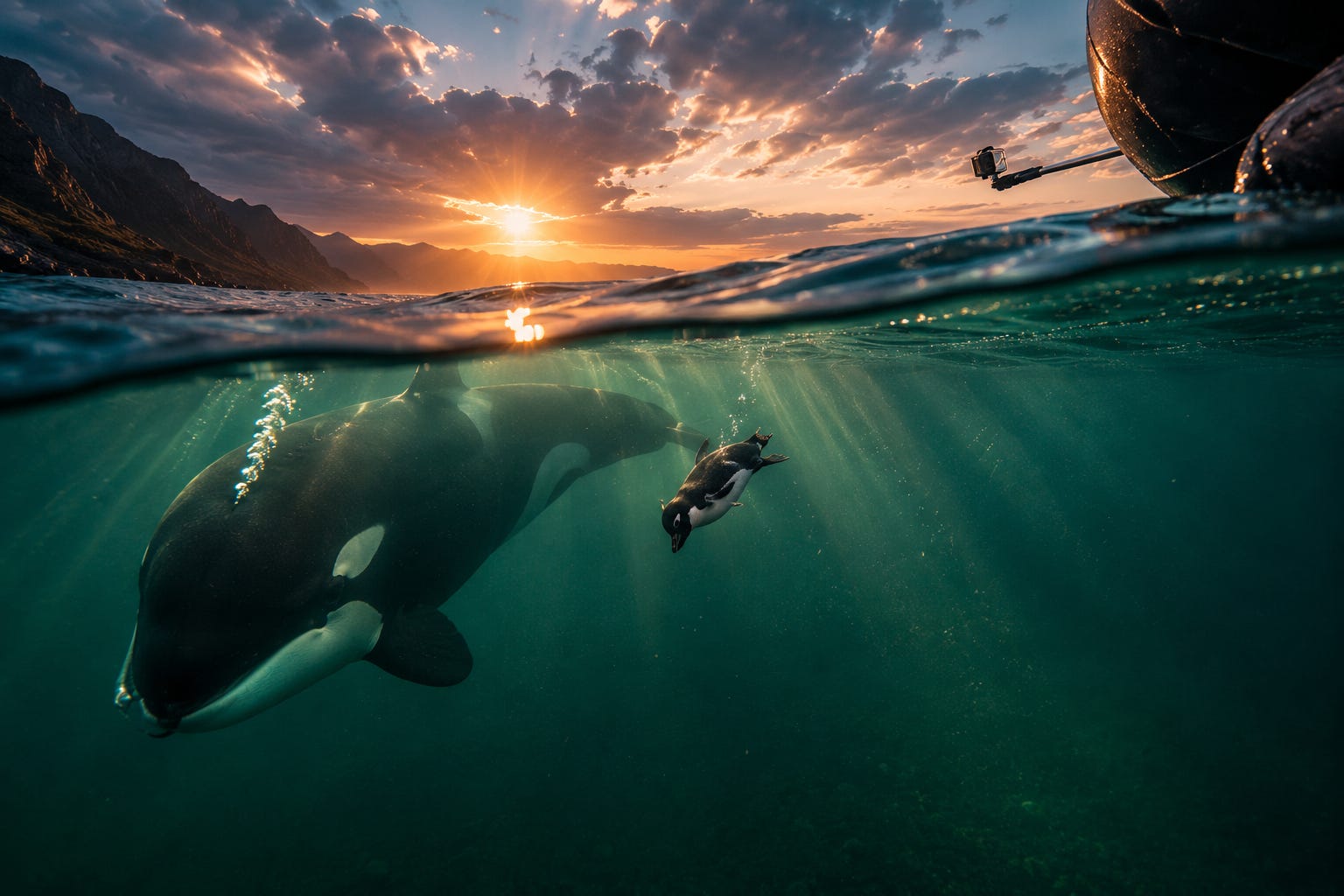
For decades, scientists have understood that orcas are among the most intelligent creatures on Earth. They possess complex languages, teach hunting strategies across generations, maintain lifelong family bonds, mourn their dead, and even develop regional cultures unique to specific pods. But a recently documented pattern of behavior has left researchers astonished in an entirely new way: wild orcas voluntarily approaching humans and offering them food.
Over a span of more than twenty years, researchers documented 34 separate incidents across oceans near places like California, Norway, and New Zealand in which orcas deliberately brought prey to humans. These were not accidental encounters. The orcas often swam directly toward swimmers, divers, boats, or people near shore carrying gifts that included fish, seabirds, stingrays, jellyfish, turtles, and other marine animals. In many cases, the orca carefully placed the item near the human and then backed away slightly, almost as if waiting for a response.
What makes the behavior even more extraordinary is the persistence. When humans ignored the offering or pushed it away, several orcas retrieved the item and offered it again. Some repeated the gesture multiple times. Researchers noted that this mirrors “provisioning” behavior within orca communities themselves, where sharing food strengthens social bonds, teaches younger pod members, and reinforces trust. Orcas are not random hunters; they are deeply social beings that learn from one another and pass traditions across generations.
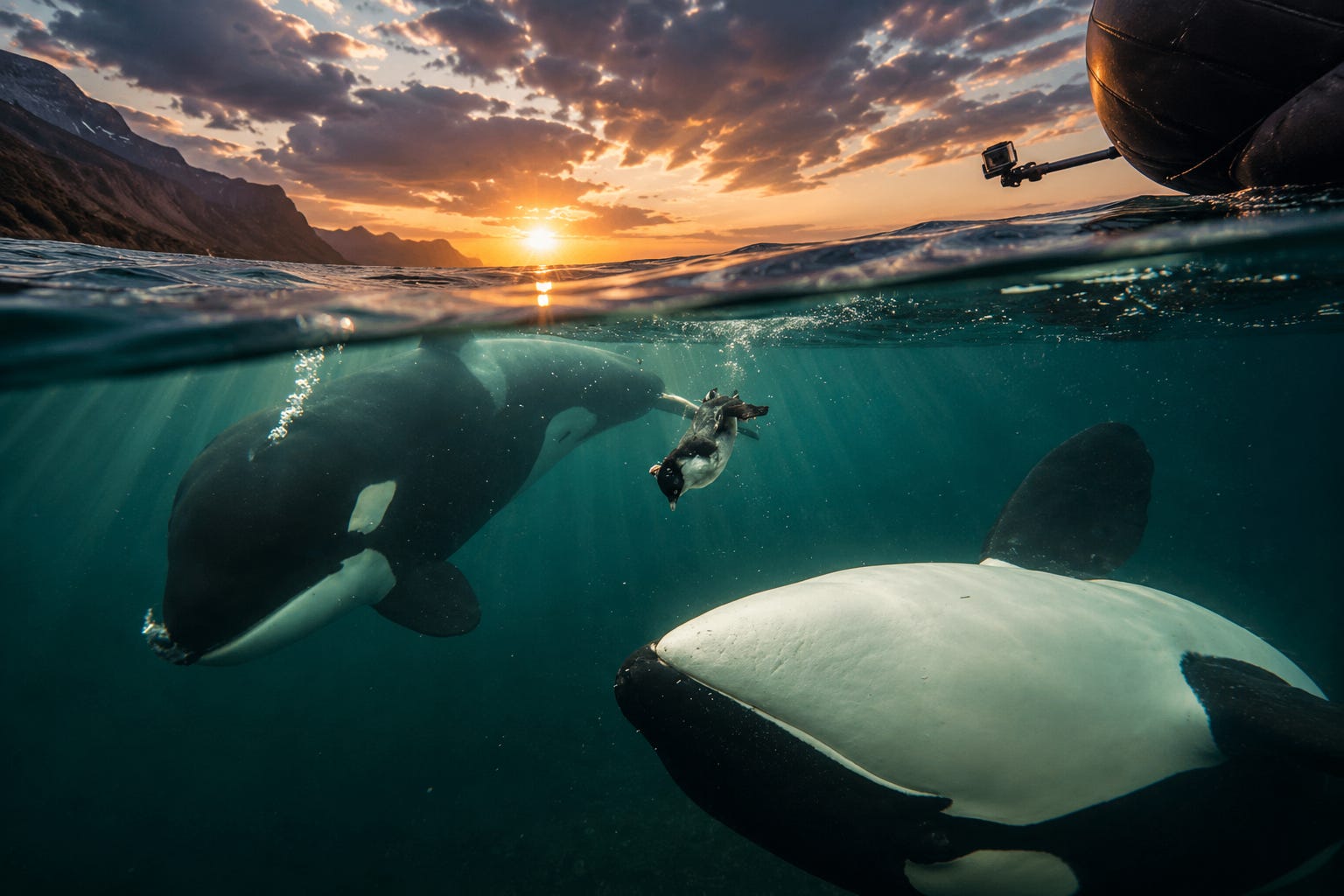
Scientists believe the motivations behind these interactions may include curiosity, play, social experimentation, or even an attempt at cross-species relationship building. Some researchers cautiously suggest the behavior could reveal a form of “theory of mind” — the awareness that another being possesses thoughts, feelings, and perspectives separate from one’s own. In simple terms, the orca may recognize the human as an individual capable of receiving, responding to, or appreciating a gift.
That possibility is breathtaking.
Human beings have long assumed intelligence belongs almost exclusively to us. Yet beneath the ocean surface swims a creature capable of communication dialects, inherited culture, coordinated teamwork, emotional attachment, and perhaps even intentional generosity toward an entirely different species. Orcas already teach each other hunting techniques with remarkable precision. Some pods wear dead salmon on their heads as temporary “fads.” Others cooperate in highly strategic hunts requiring timing and role assignment. Now researchers are confronting evidence that these animals may also seek connection beyond their own kind.
And perhaps that longing to connect points to something deeper woven into creation itself.
The Bible teaches that life was not created in chaos or isolation. God designed a world filled with relationship, communication, and wonder. When we see astonishing intelligence in creation, it should not diminish humanity’s value, it should magnify the wisdom of the Creator who formed all living things.
Scripture repeatedly reminds us that creation reflects God’s glory in ways that leave humanity humbled. The same God who crafted galaxies also designed minds beneath the sea capable of social complexity we are only beginning to understand. Every new discovery becomes another reminder that human knowledge is limited, while God’s wisdom is immeasurable.
The behavior of these orcas also offers a quiet spiritual picture. They approached humans not with violence, but with an offering. Again and again, they extended something outward, waiting for a response. In many ways, God does the same with us. He continually reaches toward humanity through grace, truth, mercy, creation, Scripture, and Christ Himself. Yet many people ignore His invitation, misunderstand it, or push it aside.
Still, He reaches again.
The persistence of those orcas, returning with the offering after rejection — reflects something profoundly familiar about divine love. God does not abandon humanity after one refusal. Through patience and compassion, He continues calling hearts toward relationship with Him.
There is another lesson hidden here too: wonder leads to worship. Modern life often dulls our sense of awe. But moments like these awaken us again. They remind us that the world is far more mysterious, intelligent, and beautifully designed than we imagined. Creation is not empty machinery; it is filled with signs of artistry, order, and purpose.
The ocean itself becomes a testimony.
Bible Verses
“But ask the animals, and they will teach you, or the birds in the sky, and they will tell you.” - Job 12:7
“How many are your works, Lord! In wisdom you made them all; the earth is full of your creatures.” - Psalm 104:24
“Great are the works of the Lord; they are pondered by all who delight in them.” - Psalm 111:2
“Since the creation of the world God’s invisible qualities, his eternal power and divine nature, have been clearly seen, being understood from what has been made.” - Romans 1:20
Take the Next Step
The next time you encounter something astonishing in creation, resist the urge to move past it too quickly. Let wonder slow you down. Let it remind you that the Creator is infinitely wiser than human understanding.
Ask yourself:
Have I lost my sense of awe at God’s creation?
Do I notice the fingerprints of God in the natural world?
Am I responding when God reaches toward me?
Creation is constantly whispering that there is more beyond ourselves. The question is whether we are listening.
God's created so many beautiful things. This was so interesting and yes the Orcas definitely reflect God's nature which is what we were also created to reflect before the fall. Thanks for sharing.