


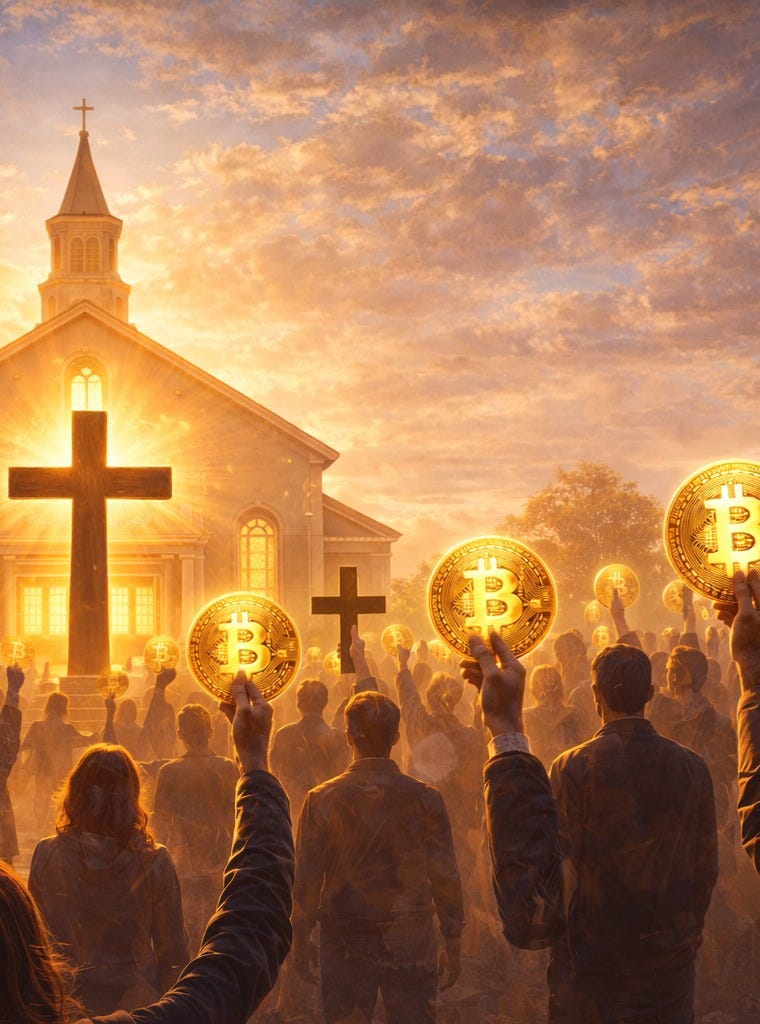
There was a time when thirty pieces of silver told the whole story.
Now it takes a digital wallet.
Across churches, podcasts, Telegram groups and conference halls, a new language is being spoken among believers. It sounds part scripture, part strategy. Words like sovereignty, inflation, freedom, and blessing sit alongside blockchain, wallets, and buy the dip. What is emerging is not just a financial trend, but a cultural one, a quiet but growing fusion of Christianity and cryptocurrency.
It is happening at a moment of global unease. War redraws borders in the Middle East. Prices rise quietly in supermarkets. Trust in institutions thins. For many, money no longer feels stable, and when stability disappears, people reach for something deeper than economics.
They reach for meaning.
Some Christians now see Bitcoin not simply as an asset, but as an answer. A hedge against inflation, yes, but also against something more intangible, a system they no longer trust. In this telling, cryptocurrency becomes a form of modern-day exodus, a way to step outside what they view as broken financial structures and into something decentralised, incorruptible, almost… moral.
There is a certain poetry to it.
Gold once sat in temple treasuries. Coins passed through the hands of emperors. Today, invisible code moves across invisible networks, and still, the same ancient question remains, what is money, and who does it serve?
The appeal is not difficult to understand. Inflation has eaten quietly into wages. Governments print, markets wobble, and the cost of living climbs with a persistence that feels almost biblical in its inevitability. In that environment, Bitcoin’s fixed supply begins to look less like a technical feature and more like a promise.
A promise that cannot be diluted.
For some believers, that promise resonates with scripture itself, the idea of honest weights and measures, of systems not manipulated behind closed doors. It is framed not as rebellion, but as restoration.
And yet, history whispers caution.
Because the church has been here before.
From indulgences to prosperity preaching, from gold-plated pulpits to televangelists promising abundance, the intersection of faith and money has always carried risk. Not because money is evil, but because it is powerful. And power, when wrapped in the language of God, becomes difficult to question.
That is where the tension lies today.
In one corner, there are those who see cryptocurrency as a tool, a neutral instrument that can be used wisely or poorly, much like any other form of wealth. They speak of stewardship, of investing only what one can afford to lose, of patience and discipline. Quiet voices, often less visible, but grounded.
In the other, louder space, there are promises. Wealth framed as destiny. Market dips described as divine opportunity. Losses explained away as tests of faith. It is here that the line begins to blur, where financial risk starts to wear spiritual clothing.
And that is where people get hurt.
Already, there are stories of believers drawn in by trust, by shared language, by the comfort of hearing scripture alongside strategy, only to find that the market does not respond to prayer in the way they expected. Millions have been lost in schemes that spoke the language of faith but followed the logic of greed.
It is an old story in a new form.
“For the love of money is the root of all kinds of evil.” (1 Timothy 6:10)
Not money itself, but the love of it. The subtle shift from using wealth to trusting in it.
And perhaps that is the deeper question beneath the headlines.
Is Bitcoin becoming a tool in the hands of believers, or is it quietly becoming something they place their hope in?
Because the language matters. When investment becomes identity, when charts begin to shape conviction, when a rising price feels like confirmation and a falling one feels like testing, something has already shifted.
The early church had no blockchain. No portfolios. No strategies.
And yet, it changed the world.
Not through accumulation, but through surrender. Not through decentralisation, but through devotion. Not through escaping systems, but through transforming hearts.
There is a moment in all of this, a quiet one, easily missed.
A believer sits, perhaps late at night, watching a chart flicker between red and green. The numbers rise, then fall. Hope follows. Then fear. Then justification. Then resolve.
And somewhere in the middle of that movement, a question forms, simple, but piercing:
Where is my trust, really?
Not in theory, but in practice.
Because markets will rise and fall. They always have. Empires too. Currencies come and go, from denarii to dollars to digital coins. Each one, in its time, feels permanent.
None of them are.
“Do not store up for yourselves treasures on earth, where moths and vermin destroy… but store up for yourselves treasures in heaven.” (Matthew 6:19–20)
This is not an argument against investment. It is not even an argument against Bitcoin. It is a reminder of proportion.
Use it, if you must. Learn it, if it serves you. Build with it, if it helps you live wisely.
But do not worship it.
Because no coin, however secure, can carry the weight of a soul.
And no market, however promising, can deliver peace.
That was never its role.
And it never will be.
Amen.