


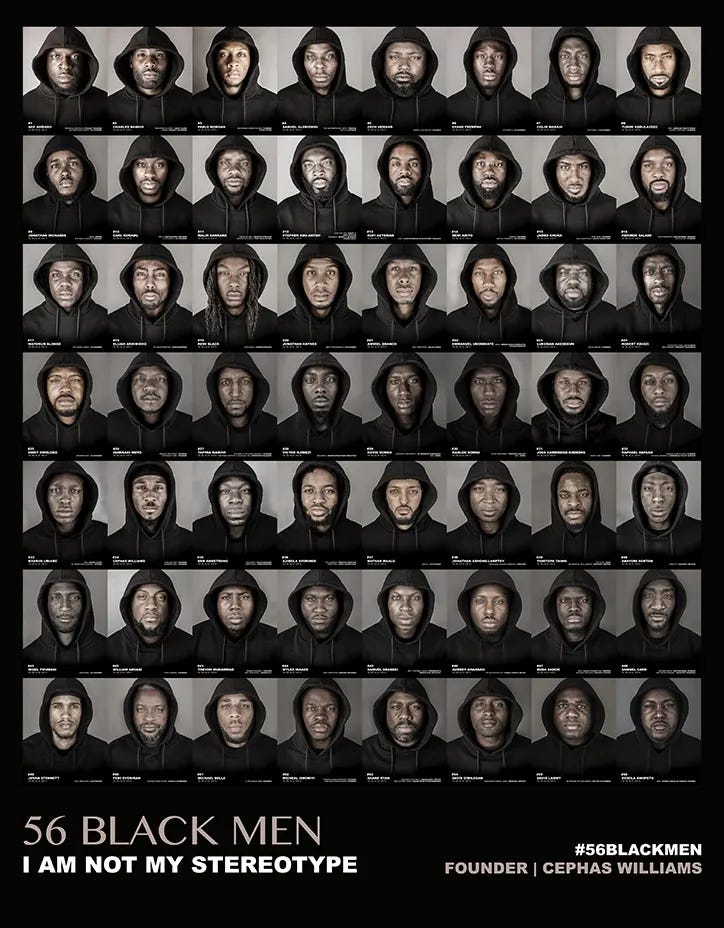
I Am Not My Stereotype
In a world that often reduces people to labels, a simple but powerful statement emerges:
“I am not my stereotype.”
No noise.
No performance.
Just presence.
And in that stillness, something breaks.
Because stereotypes don’t just live in systems—they live in assumptions. In glances. In expectations. In stories told before a word is even spoken.
But here’s the deeper truth:
God has never seen people the way the world does.
God Looks at the Heart
Scripture reminds us:
“Man looks at the outward appearance, but the Lord looks at the heart.” — 1 Samuel 16:7
Where the world labels, God listens.
Where the world reduces, God restores.
Where the world assumes, God knows.
This campaign does something powerful—it forces us to pause and confront the gap between what we see and what is real.
Because every face carries a story.
Every life carries purpose.
Every person carries the image of God.
The Danger of a Single Story
Stereotypes are dangerous because they simplify what God created to be complex.
They take identity and shrink it.
They take dignity and distort it.
But the Word of God speaks differently.
“So God created mankind in His own image…” — Genesis 1:27
Not in categories.
Not in assumptions.
Not in fear.
In His image.
That means no person is a headline.
No person is a statistic.
No person is what others have decided they are.
Jesus and the Rejected
If you read the Gospels closely, you’ll notice something:
Jesus was always drawn to the people others misunderstood.
The woman judged by her past
The tax collector rejected by society
The leper avoided by everyone else
And again and again, He did the same thing:
He saw beyond the label.
He spoke to the person.
He restored dignity.
He rewrote identity.
Breaking What We Carry
It’s easy to point at society and say, “that’s the problem.”
But this campaign quietly asks something harder:
What do we carry?
What assumptions have we absorbed without questioning?
What narratives have we accepted without knowing their weight?
Because transformation doesn’t start “out there.”
It starts in the heart.
A Faith That Sees Differently
True faith doesn’t close us off—it opens our eyes.
It teaches us:
To love beyond difference
To listen before judging
To see people as God sees them
And that changes everything.
Because when you begin to see people through God’s lens, stereotypes lose their power.
A New Way Forward
The message “I am not my stereotype” is more than a statement.
It’s a reclaiming.
A refusal to be defined by a world that often gets it wrong.
And in many ways, it echoes what Scripture has been saying all along:
“Therefore, if anyone is in Christ, the new creation has come…” — 2 Corinthians 5:17
Identity is not given by society.
It is not limited by perception.
It is not bound by history.
It is found in truth.
The Final Reflection
Maybe the real question this campaign leaves us with is not just:
“How do others see me?”
But:
“How do I see others?”
Because every time we choose to see with compassion instead of assumption,
with grace instead of judgment,
with truth instead of stereotype—
we reflect the heart of God.
And in a world quick to label,
that might be one of the most powerful things we can do.