


In economics, there is a quiet rebellion called the gift economy. It does not shout. It does not invoice. It simply gives. Long before contracts and currencies, ancient communities survived not by keeping score but by refusing to let one another starve. A man did not ask what he could gain. He asked who might not make it through the night.
That world was not soft. It was harsh, uncertain, often brutal. Crops failed. Winters killed. Hunger was not a theory, it was a face you recognised. And yet, in the middle of that, something stubborn and beautiful endured. People gave anyway.
Fast forward to now, where everything is priced, tracked, measured. Even kindness sometimes feels like a transaction waiting for applause. And then, quietly, almost embarrassingly simple, something breaks through.
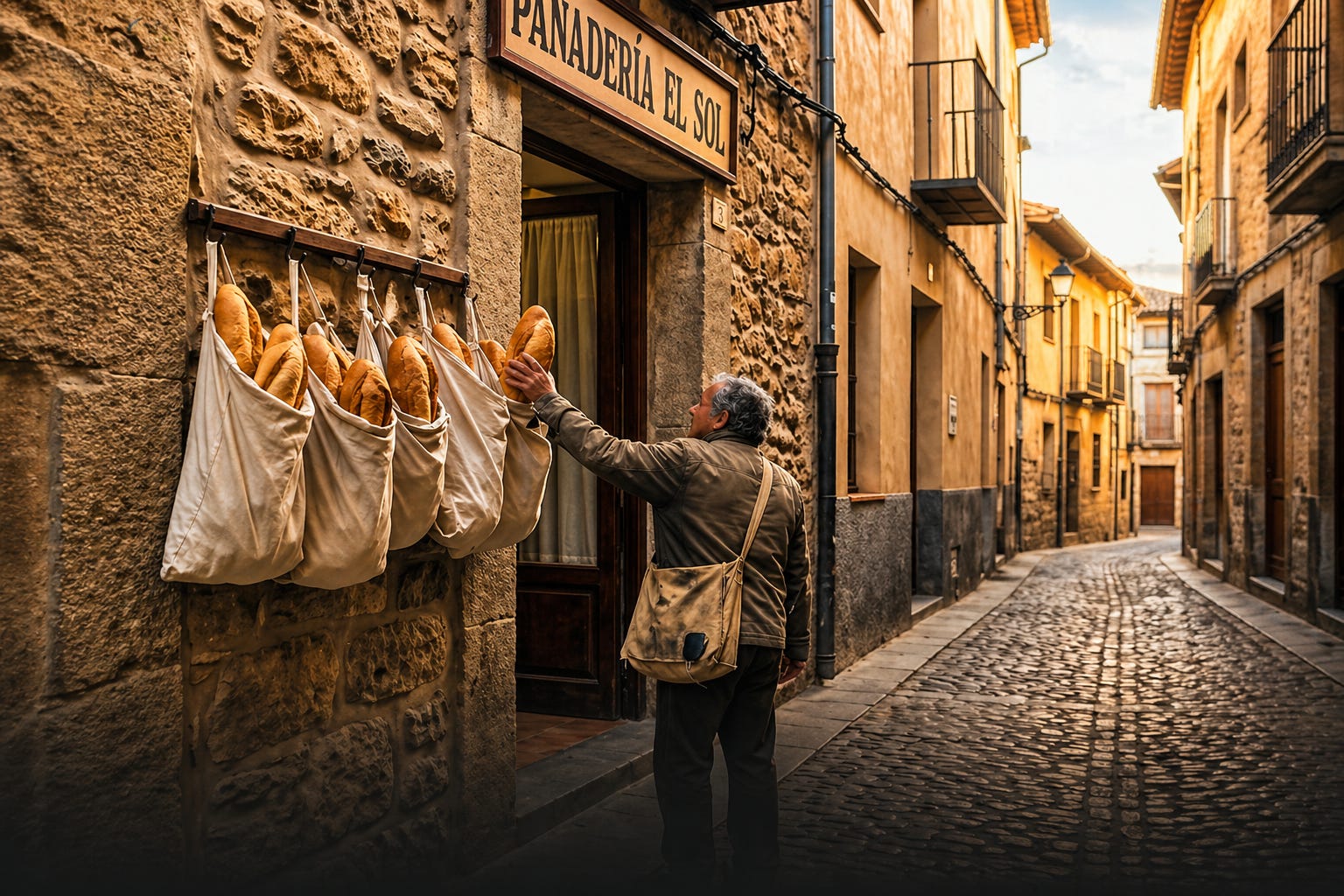
In a small Spanish bakery, Panadería La Concepción, bread is left hanging outside. Not as waste, but as provision. It is called pan pendiente. Suspended bread. Someone has already paid for it. Someone you will never meet. No forms. No explanations. No dignity stripped away in the asking. Just bread, waiting.
There is something almost offensive about it in a world that demands fairness. Because it is not fair. One pays. Another receives. No balance is restored. No ledger corrected. And that is exactly the point. Because this is not just about bread. It is about blood.
We speak of grace as if it were light, soft, almost weightless. But grace is violent in its origin. It was carved out of sacrifice. It was purchased at a cost no one watching could ignore. Wood, nails, torn flesh, breath slipping away. The kind of moment that does not fit neatly into polite conversation.
And yet what came from that moment was not a system of repayment. It was an open door. Freely given. No small print. No quiet clause waiting to catch you later. Just like the bread.There is something deeply human in the resistance to this. We prefer control. We prefer earning. We prefer to feel worthy. Because if we can earn it, we can understand it. And if we can understand it, we can contain it. But grace refuses to be contained. It hangs there, like bread outside a bakery, unsettling in its simplicity. Take it. Or walk past it. Some do both.
However, imagine explaining this system to someone obsessed with balance sheets. Someone, somewhere, paid for food they will never eat, just in case a stranger walks by hungry. No return. No visibility. No strategy.
It sounds almost foolish. Until you are the one who is hungry. Until you are the one who needed something you could not pay for. And then suddenly, it is not foolish at all. It is everything.
Spiritually, we live surrounded by suspended provision. Forgiveness waiting before confession is even formed. Mercy offered before the apology is complete. Hope placed within reach before we feel deserving of it.
The question is not whether it exists. The question is whether we will take it without trying to earn it, and whether we will give it without trying to control it.
Because the deeper truth is this. You cannot truly receive grace and remain tight fisted. It will change you. It will loosen something. It will make you dangerously generous in a world that prefers caution.
And that is where the discomfort returns.
To live this way is to step outside the logic of the world. To give when it does not make sense. To help when it will not be returned. To love when it is not mirrored back.
It will look naive to some. Wasteful to others. But to the one who receives it at the exact moment they need it, it will feel like survival. Like breath. Like bread.
Scripture Reflection
“Freely you have received; freely give.” — Matthew 10:8
“And do not forget to do good and to share with others, for with such sacrifices God is pleased.” — Hebrews 13:16
“Give, and it will be given to you… For with the measure you use, it will be measured to you.” — Luke 6:38
Take the Next Step
Create a quiet moment of disruption in someone’s life. Pay for something they cannot repay. Leave provision where no one will trace it back to you. Let it feel uncomfortable. That is how you know it is real.
And then pause. Because if you are honest, you have already eaten from bread you did not buy.